Continuing Activities - Month Eleven
Mar. 28th, 2020 10:21 am![[personal profile]](https://www.dreamwidth.org/img/silk/identity/user.png) smallhobbit
smallhobbitI've completed three FutureLearn courses this month:
The first was Great South Land: Introducing Australian History by the University of Newcastle, Australia. I had been drawn to the idea of finding out more about Australian History when I watched Michael Portillo's Great Australian Railways Journeys and this seemed the ideal opportunity. The course covered the earliest history, from Aboriginal Deep Time History, through first contact to the arrival of the convicts. It was the first three weeks of a twelve week university course and therefore suffered from trying to serve both university students and the more general participant; a couple of the sessions, on the correct use of references when writing a report, were completely irrelevant. I learnt something, but would like to have had a broader introduction. I was also slightly uncomfortable when reference was made to Aboriginal beliefs and the importance of respecting them was stated, but then current theories of the migration of peoples were insisted on as facts.
The second was Introduction to American History: From Reconstruction to War, 1865-1919 also by the University of Newcastle, Australia. And again the first three weeks of a twelve week course. Up to now I've shied away from American history, preferring British and European history, but some more of Portillo's railroad journeys in the US and Canada have given me a starter and I thought I'd like to learn more. The course covered from the Civil War, through reconstruction and segregation, to American foreign policy in the latter part of the nineteenth century to the First World War. There was a lot of the same lecturer talking in his study with an Australian accent, which became boring after a while - almost as if the participants were sat in a lecture, which isn't the way I like my courses. The concentration was on the black experience, which I know is a major part, but without a comparison of what was happening elsewhere it lacked context. I did participate in the assignment on assessing other resources - again really more relevant to university students, since it was looking at the reliability of sources - and went with an article from the Imperial War Museum website about American soldiers in WWI, a subject I already knew something about.
My third course was Preserving Norwegian Stave Churches by the Norwegian University of Science and Technology. I knew absolutely nothing about stave churches, but the two week course fitted nicely in to my diary. There are only 28 stave churches left in Norway, although there were many more in the past. They are of a unique construction and there's an example here: Borgund Stave Church. I found the first week quite hard, but on reflection the concentration paid off, as I've definitely learnt a lot about the churches. The second week which talked about the craftmanship and restoration was more interesting, with the craftsmen describing what they were doing, so it wasn't just lecturers talking. A bonus wasverdande_mi very kindly telling me about their local churches and sharing some of their photos of stave churches with me, which added an extra layer of relevance.
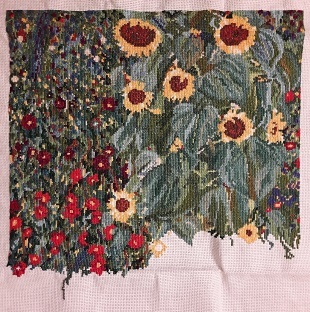
And my cross stitch continues to grow as well:

The first was Great South Land: Introducing Australian History by the University of Newcastle, Australia. I had been drawn to the idea of finding out more about Australian History when I watched Michael Portillo's Great Australian Railways Journeys and this seemed the ideal opportunity. The course covered the earliest history, from Aboriginal Deep Time History, through first contact to the arrival of the convicts. It was the first three weeks of a twelve week university course and therefore suffered from trying to serve both university students and the more general participant; a couple of the sessions, on the correct use of references when writing a report, were completely irrelevant. I learnt something, but would like to have had a broader introduction. I was also slightly uncomfortable when reference was made to Aboriginal beliefs and the importance of respecting them was stated, but then current theories of the migration of peoples were insisted on as facts.
The second was Introduction to American History: From Reconstruction to War, 1865-1919 also by the University of Newcastle, Australia. And again the first three weeks of a twelve week course. Up to now I've shied away from American history, preferring British and European history, but some more of Portillo's railroad journeys in the US and Canada have given me a starter and I thought I'd like to learn more. The course covered from the Civil War, through reconstruction and segregation, to American foreign policy in the latter part of the nineteenth century to the First World War. There was a lot of the same lecturer talking in his study with an Australian accent, which became boring after a while - almost as if the participants were sat in a lecture, which isn't the way I like my courses. The concentration was on the black experience, which I know is a major part, but without a comparison of what was happening elsewhere it lacked context. I did participate in the assignment on assessing other resources - again really more relevant to university students, since it was looking at the reliability of sources - and went with an article from the Imperial War Museum website about American soldiers in WWI, a subject I already knew something about.
My third course was Preserving Norwegian Stave Churches by the Norwegian University of Science and Technology. I knew absolutely nothing about stave churches, but the two week course fitted nicely in to my diary. There are only 28 stave churches left in Norway, although there were many more in the past. They are of a unique construction and there's an example here: Borgund Stave Church. I found the first week quite hard, but on reflection the concentration paid off, as I've definitely learnt a lot about the churches. The second week which talked about the craftmanship and restoration was more interesting, with the craftsmen describing what they were doing, so it wasn't just lecturers talking. A bonus was
verdande_mi very kindly telling me about their local churches and sharing some of their photos of stave churches with me, which added an extra layer of relevance.And my cross stitch continues to grow as well:


no subject
Date: 2020-03-28 11:57 am (UTC)no subject
Date: 2020-03-28 12:08 pm (UTC)no subject
Date: 2020-03-28 06:51 pm (UTC)I really need to get back to stitching.
no subject
Date: 2020-03-28 09:43 pm (UTC)no subject
Date: 2020-03-28 10:09 pm (UTC)I'm just finding it difficult to fit in all the things I want to do. The garden work is urgent, I need to get the brambles down before they grow any bigger, even if I can't dig the roots out because I can't get at the garden fork. The padlock on the shed door has succumbed to the wet winter, despite it being designed to deal with wet weather. *sigh*
no subject
Date: 2020-03-29 12:57 pm (UTC)no subject
Date: 2020-03-29 05:58 pm (UTC)no subject
Date: 2020-03-28 12:36 pm (UTC)no subject
Date: 2020-03-28 12:49 pm (UTC)Fortunately the attraction of all these shiny new things to learn about (in a way that appeals to me) is a strong pull on my brain and by concentrating on the learning I blank everything else out. Many of them have little tests and I hate not doing well at them.
no subject
Date: 2020-03-28 02:16 pm (UTC)Love the cross stitch!!
no subject
Date: 2020-03-28 02:24 pm (UTC)And thank you - I'm delighted to see your icon!
no subject
Date: 2020-03-28 03:42 pm (UTC)I like how varied your courses are. It is a shame as you say when they focus only on one experience or state certain things as facts. I agree that leaves a loss of context, which isn't always easy to obtain outside history classes due to having to know and/or find the appropriate historical books.
Happy though the Stave Churches was more successful! Also incredible design. Must be incredible to be in one.
no subject
Date: 2020-03-28 03:53 pm (UTC)I take whatever's on offer at the time and see how it goes, which is how I end up finding things I would never have thought about really interesting.
The interiors of the Stave churches are also impressive, with some great paintings on the plaster dating back hundreds of years. You can understand why they want to preserve them.
no subject
Date: 2020-03-28 03:55 pm (UTC)The Stave churches do sound remarkable, I hope they are successful in their attempts to preserve them.
no subject
Date: 2020-03-28 05:23 pm (UTC)Also, that Australian course sounds really interesting (well, the actual content, not the bit about references).
no subject
Date: 2020-03-28 05:53 pm (UTC)The Australian course was interesting, and now I really want to build on it.
no subject
Date: 2020-03-28 06:33 pm (UTC)I've been listening to Vintage Murder by Ngaio Marsh the last few days, I couldn't help thinking of you, because you're the only person I know who also read her books. I was just telling my husband today how I enjoyed learning a bit about New Zealand from that book, so I very much understand your interest in Australia as well. I'd like to know more about their history, too.
no subject
Date: 2020-03-28 06:55 pm (UTC)I'm glad you're listening to Vintage Murder - I do enjoy the Inspector Alleyn mysteries.
no subject
Date: 2020-03-28 08:55 pm (UTC)There's a Great Courses course on great cathedrals of the world, and one of the episodes is a stave church. So great.
no subject
Date: 2020-03-28 09:04 pm (UTC)Yes, I'm really taken with stave churches.
no subject
Date: 2020-03-29 04:08 pm (UTC)no subject
Date: 2020-03-29 04:47 pm (UTC)I prefer the courses which aren't quite as lectured - yes, they have lecturers talking, but they often have a number of people speaking on their own specialist subject, and they do so from the relevant location - like the Stave churches, where the craftsmen were working on site. All of which I find much more engrossing.
no subject
Date: 2020-03-29 09:30 pm (UTC)The cross stitch is coming along very nicely! :-)
no subject
Date: 2020-03-30 10:20 am (UTC)And thank you very much!