![[personal profile]](https://www.dreamwidth.org/img/silk/identity/user.png) smallhobbit
smallhobbitWell, yes, I do like trying out new things. Not simply because they're new and shiny, but because when I'm tempted to think 'I can't do that, I've never done it before' I like to say 'it's new, try it!'
Imperial College in London has started running various events online. Previously they've held events known as Imperial Lates (because they're in the evening) face to face, but they've now adapted a number of these events to hold online. Earlier this month, in honour of Valentine's Day, they held a week of events relating to the heart and relationships. One event in particular appealled, which was the idea of creating a Valentine's Card with an artist, a poet and a medical doctor who is doing cardiac research.
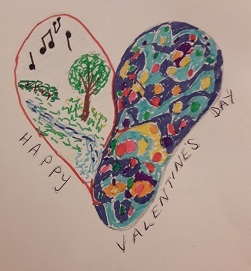
It was fun, and I made a bright and original card:
Next month they're doing a week with activities around the sun, so I've signed up to receive information when it comes out.
I've also followed two FutureLearn courses:
The first Let's Learn Thai Language by Universiti Malaya, was a two week introduction to Thai. There was a lot of vocabulary and phrases provided, and I still wouldn't be able to say a word, but it gave a flavour of the language.
The second was Understanding English Dictionaries by Coventry University. I learnt a few things, but wasn't gripped by the subject. A number of the participants who commented were very in favour of hard copy dictionaries, and quite negative towards online versions, whereas nowadays I always look online. The course itself did cover online dictionaries. One comment which amused me was that using a physical dictionary one could end up learning all sorts of other words - which of course would never happen to me when I look for something online!
Imperial College in London has started running various events online. Previously they've held events known as Imperial Lates (because they're in the evening) face to face, but they've now adapted a number of these events to hold online. Earlier this month, in honour of Valentine's Day, they held a week of events relating to the heart and relationships. One event in particular appealled, which was the idea of creating a Valentine's Card with an artist, a poet and a medical doctor who is doing cardiac research.
It was fun, and I made a bright and original card:
Next month they're doing a week with activities around the sun, so I've signed up to receive information when it comes out.
I've also followed two FutureLearn courses:
The first Let's Learn Thai Language by Universiti Malaya, was a two week introduction to Thai. There was a lot of vocabulary and phrases provided, and I still wouldn't be able to say a word, but it gave a flavour of the language.
The second was Understanding English Dictionaries by Coventry University. I learnt a few things, but wasn't gripped by the subject. A number of the participants who commented were very in favour of hard copy dictionaries, and quite negative towards online versions, whereas nowadays I always look online. The course itself did cover online dictionaries. One comment which amused me was that using a physical dictionary one could end up learning all sorts of other words - which of course would never happen to me when I look for something online!


no subject
Date: 2021-02-24 01:31 am (UTC)no subject
Date: 2021-02-24 08:16 am (UTC)no subject
Date: 2021-02-24 03:40 am (UTC)no subject
Date: 2021-02-24 08:17 am (UTC)no subject
Date: 2021-02-24 04:35 am (UTC)I usually use online dictionaries too, they are handy when you're actually on a computer writing. As for learning other new words, Dictionary.com has 'word of the day' and comes up with some great words, some I know and some I've never heard of.
no subject
Date: 2021-02-24 08:19 am (UTC)Quite. As I said in the course comments it is much easier using the online dictionary when it's to hand.
no subject
Date: 2021-02-24 04:57 pm (UTC)I do like hard copy dictonaries, but online is so easy these days, though if I would be ever in doubt with something online I would refer to my physical dictonary.
When I get back into learning Polish I know I'll favour the Polish-English and vice versa dictonaries over online for knowledge of their accuracy.
no subject
Date: 2021-02-24 05:04 pm (UTC)no subject
Date: 2021-02-25 04:59 pm (UTC)no subject
Date: 2021-02-24 10:28 pm (UTC)Echoing Luthienberen about language learning (one day I will stop talking about Dutch, but this day is not that day ^^") - if I'm reading a physical, paper book in Dutch, I will tuck myself into bed and use a physical, paper dictionary to look up new words. My most-used dictionary I bought secondhand maybe 25 years ago and it dates from the 1970s, but the language hasn't changed that much, and I know time, money, experience and expertise was spent on the dictionary and I can safely rely on it.
But when I'm reading, watching or listening to something online, I go straight to looking things up online. It's not just the convenience - it's because I can now go beyond dictionaries. The Dutch online dictionary that I use is very good but can be hit or miss on occasion. So I also look words and phrases up on a site that shows me those words in real sentences and gives me idiomatic English translations. Also I can look at sites dedicated to the Dutch language - sites that are aimed at learners and those that are aimed at native speakers. I can search for [Dutch word] and "betekenis" (meaning), and get a whole range of sources - dictionaries, blogs, the Dutch Wikipedia, prescriptive and descriptive language sites - to see a bigger picture of what the word means. And most importantly, I can get up to date information. Language is a living and ever-changing thing - it can be so interesting to witness native speakers arguing about language use because they personally say different things.
One comment which amused me was that using a physical dictionary one could end up learning all sorts of other words - which of course would never happen to me when I look for something online! That made me smile ^_____^ Yes, looking things up online just offers so much more opportunity to make connections and learn things that you weren't actively searching for.
no subject
Date: 2021-02-25 08:58 pm (UTC)Yes, there's far greater scope on the internet - and no need to use half a dozen large tomes. But I do understand about a physical dictionary and physical book.
Clearly the person making that comment hadn't experienced the delights of finding out all sorts of totally irrelevant things when searching online.
no subject
Date: 2021-02-27 01:52 pm (UTC)Sometimes the flavour of a language can be really useful. I have that for Chinese (Mandarin), Urdu, and Punjabi, and in a slightly deeper way, Arabic. I also remember a taster session on Japanese. It's always interesting, because you pick up bits and pieces about culture, and also, when you hear the language on radio or TV you hear the separate words instead of garbled sound. Enjoy your Thai!
no subject
Date: 2021-02-27 02:21 pm (UTC)That was really what I was hoping for - just a flavour, which I think it has given me.
no subject
Date: 2021-03-01 04:11 pm (UTC)It's great that Imperial College has started running events online. The Valentine's Day card event must have been fun, especially if you were able to collaborate with other people.
Both of those FutureLearn courses seem interesting. It's good that you were able to at least get a flavour of the Thai language with the Let's Learn Thai Language course. I'm sorry that the Understanding English Dictionaries course wasn't quite what you were looking for. I have to admit that most of the time I also look things up online rather than using a physical dictionary.
no subject
Date: 2021-03-01 05:06 pm (UTC)I think the majority of people do look things up online - it's so much easier. I had hoped the course would have covered more in that respect.